Can our township adopt an ordina...
Yes. The new Section 108(6) of the Land Division Act expressly permits local ordinances to exceed the state baseline; there is no numerical ...
Read MorePhone 517.381.0100
High Contrast
High Contrast

4151 Okemos Road
Okemos, MI 48864
We are involved in our communities, our profession, and our clients' associations and activities.
On December 23, 2025, Governor Whitmer signed Senate Bill 23 into law as Public Act 58 of 2025, amending Michigan’s Land Division Act (“LDA”), 1967 PA 288, MCL 560.108. It has two phases: first in March of this year and then becoming fully in force in March 2027. Thus, it is already partially in effect, presenting a unique opportunity for municipalities to respond to and shape development within their communities with a review of their land division ordinance.
Adopted in 1997, the Land Division Act significantly revised the prior Subdivision Control Act. For over 50 years, these two state laws established the framework for the uniform and orderly partitioning of property; that is, regulating how and when one large parcel of real property could be split into two or more smaller parcels. The amendments will have full effect on March 25, 2027.
Public Act 58’s stated purpose is to “incentivize more construction of affordable housing depending on the local ordinance governing the build site.” The headline change is straightforward: the maximum number of parcels that can be created from the first 10 acres of a parent parcel is increasing from 4 to 10. More available divisions and more parcels allow construction of more single-family homes. But the full significance of Public Act 58 extends far beyond that single number. For nearly three decades, the LDA functioned as a ceiling — a cap that landowners, developers, and local governments could not exceed. Under the amended framework, it now functions as a floor — a baseline that local governments may raise through their own ordinances. Most importantly for local governments, the new 10 parcel floor will be automatically increasing throughout the state.
Phase 1 – Now in Effect (March 24, 2026). The first phase of PA 58 activated Section 108(6), which gives townships, cities, and villages (and some counties) with land division authority the right to adopt ordinances permitting a parcel (or tract) to be divided into more parcels than the statutory baseline. This local-option authority is already effective. The amended law imposes no numerical cap on the number of divisions a local ordinance may authorize. A township could permit 10, 12, or even 20 parcels from all currently existing parcels, provided the division and resulting parcels are in compliance with applicable — and locally tailored — standards.
The newly created subsection (6) reads as follows:
“[A] parcel or tract may be partitioned or split at any time into a greater number of parcels or tracts than otherwise authorized by this section if the partitioning or splitting is authorized by and complies with standards set forth in an ordinance of the municipality or county having authority to approve or disapprove a division under section 109(1).” [MCL 560.108(6).]
This is a historic shift in the relationship between state law and local authority. For the first time in the LDA’s history, local governments have been given express authority to exceed — not merely meet — the state’s division formula. Also, note well, that this new language applies to all “parcels” in the community and not simply the “parent parcels” in the state’s second phase. Municipalities have a significantly broader scope than the state’s baseline (discussed below). The number of potential divisions as well as the standards required to secure them permits local tailoring. Elected officials should carefully consider whether their township, city, or village will use the new authority or allow the state baseline to govern its community.
Phase 2 – Statewide Increase (March 24, 2027). In the second phase, the baseline number of divisions for the first 10+ acres of parent parcels increases substantially statewide. The applicable formula—“the first 10 acres or fraction thereof in the parent parcel or parent tract”—is unchanged. The “first 10 acres” means the parent parcel can be smaller than 10 acres—and the number of resulting parcels still increases from 4 to 10. Counterintuitively, the “fraction” language extends to the additional fractional acreage over the first whole 10 acres until a second whole 10 acres is realized; this means that a 19-acre parent parcel has the same number of potential resulting parcels as a nine-acre parent parcel.
| Parent Parcel Acreage | Prior Maximum Parcels | New Maximum Parcels |
| First 10 acres or fraction (effectively 19.99 acres) | 4 | 10 |
| Each additional whole 10 acres (starts at 20 acres and goes up to 120 acres) | 1 additional | 1 additional |
| Each additional 40 acres (beyond 120 acres) | 1 additional | 1 additional |
The diagram below visualizes how ten resulting parcels may look compared to historical four parcel splits of a hypothetical 10-acre parent parcel.
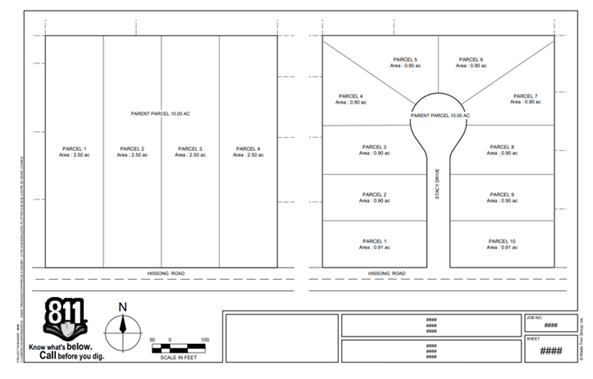
Current Framework: Four traditional parcels fronting public road.
Future Framework: Ten small parcels with a small access drive
Note that new parcels are available only to parent parcels or tracts. A “parent parcel” is a legally recognized, distinct piece of real property that existed as of March 31, 1997. See MCL 560.109(i). Under the LDA, the number of available divisions has always been calculated from this March date and parent parcels. This has not changed.
Public Act 58 also preserves existing re-division rights. Child parcels of at least 10 acres created under the LDA still receive additional division(s) after the 10-year waiting period. The increased splits effective next year revises the number of “original” divisions, meaning that child parcels with redivision rights will retain those rights.
Urban, suburban, and agricultural communities will all need to prepare for the coming land split applications. Landowners holding large parcels have taken notice of PA 58. Many are already inquiring with local governments about which rules will apply to proposed divisions. Townships and other municipalities may find themselves facing a wave of applications submitted under the new state framework in March 2027 and should audit their existing procedures. With a critical eye, examine your internal processes including:
How many new parcels are ultimately realized will be unique in each community, including that zoning remains applicable and may minimize concerns for municipalities with that regulatory component. For those that are zoned, certainly consider the extent that your current land division ordinance is incorporating it and other local ordinances (e.g., environmental ordinances, such as stormwater). One thing is certain: the potential for new parcels will increase into this year and the future.
Assessors, planning commissioners, zoning administrators, city or village councils, and township boards bear the lion’s share of responsibility to respond. The LDA selects the assessor as the default official to process land division applications. Yet, this varies from community to community, and it is not unusual for zoning administrators (and others) to be involved in each application. Of course, it is the Board or Council that is ultimately responsible for adopting amendments to the ordinances and setting the overall policy direction.
First, note that the new parcels created from parent parcels under the state baseline need not happen all at once. Rather, a 10-acre parent parcel may be slowly divided into one-acre residences—a new parcel every year or two. Second, the ability to obtain bonus splits—but only for parcels that retained 60% of the original parcel—does not slow or reduce new parcels under the state baseline. It is an increase from four parcels to ten—no strings attached.
The interaction between the amended LDA and local zoning should be evaluated prior to the Act’s implementation. Under MCL 560.109(1), divisions approved under the amended LDA must still satisfy the local ratio of depth-to-width, minimum width, minimum area as well as other statutory criteria such as accessibility. But the relationship between LDA approval standards and local zoning dimensional requirements, including setbacks, frontage requirements, and other standards, present new complications because of the unprecedented amount of available divisions. Updating LDA standards in coordination with a zoning review better positions the municipality so that the new divisions operate together with zoning rather than in tension with it.
To prepare for the Act, we recommend that municipalities undertake a three-step process before the statewide default takes effect on March 24, 2027.
Step 1: Audit Your Existing Ordinance
The starting point is a thorough review of the local government’s current land division ordinance, and if applicable, zoning and environmental regulatory frameworks. Key questions include:
A municipality that does not know what its current ordinance says cannot make an informed decision about what needs to change. Auditing the current language and process is a helpful first step.
Especially if the municipality will not increase the number of available divisions itself, these last two questions must be considered carefully. First, minimum parcel size is often controlled by the underlying zoning district. Are the lot sizes in the rural areas of the community still sufficient now that six new parcels may arise overnight rather than slowly via re-division rights?
Second, land divisions regulate lot width and accessibility; the latter is explicitly defined in statute. A parcel may be accessible and satisfy land division criteria if there is a proposed easement that can provide access to a street. Often a county road commission will opine whether a driveway is possible and thus accessibility satisfied. In contrast, zoning ordinances often discuss frontage directly abutting an existing road. Similarly, such frontage widths may be different from minimum parcel width and may be different depending on the type of road access. In short, definitions matter and distinctions between land division terms and zoning regulations may create tensions or complications.
Step 2: Decide Whether to Adopt a Local Override Under Section 108(6)
Public Act 58 presents townships, cities, and villages with a genuine policy choice. Each community has an opportunity to adopt an ordinance exceeding the new state baseline and allow more divisions for all parcels in the community with guardrails, standards, and procedures for those additional splits.
Key factors to evaluate when making this determination include: infrastructure capacity, future master plan goals, zoning ordinance standards, available use classifications within existing zoning districts, viable and adequate environmental regulations, agricultural preservation, and open space preservation regulations and goals.
Step 3: Draft and Adopt a Compliant Ordinance Amendment
An effective LDA ordinance amendment should ensure consistency with state law related to the increased number of parent parcel divisions. For those local units authorizing additional divisions, they may want to explore the extent Section 108(6) authorizes additional standards when reviewing permitted divisions that would exceed the Act’s new statutory baseline of 10 parcels. At the same time, consider whether certain regulatory standards would be more appropriate in the zoning ordinance.
The new baseline of available divisions creates a new normal with which local leaders will have to grapple. The new state baseline arrives March 2027. It also presents an opportunity to consider and promote growth in ways specifically tailored to each community. Those ordinances can be considered and adopted now. Our team is prepared to assist townships and other local units of government in navigating the new LDA framework.
By: Matthew Kuschel and Tammy Sordo-Vieira
This publication is intended for educational purposes only. This communication highlights specific areas of law and is not legal advice. The reader should consult an attorney to determine how the information applies to any specific situation.
Yes. The new Section 108(6) of the Land Division Act expressly permits local ordinances to exceed the state baseline; there is no numerical ...
Read MoreEarlier this month, the State of Virginia amended the Virginia Retail Franchising Act in two ways: (1) Virginia law governs all Virginia fra...
Read MoreThe Michigan Election Law requires that local clerks certify ballot question language to the County Clerk no later than the 82nd day before ...
Read MoreAt Fahey Schultz Burzych Rhodes PLC, we’ve been helping municipalities, franchised businesses, employers, and more with their legal needs since 2008. We’d love to learn how we can help you, too.